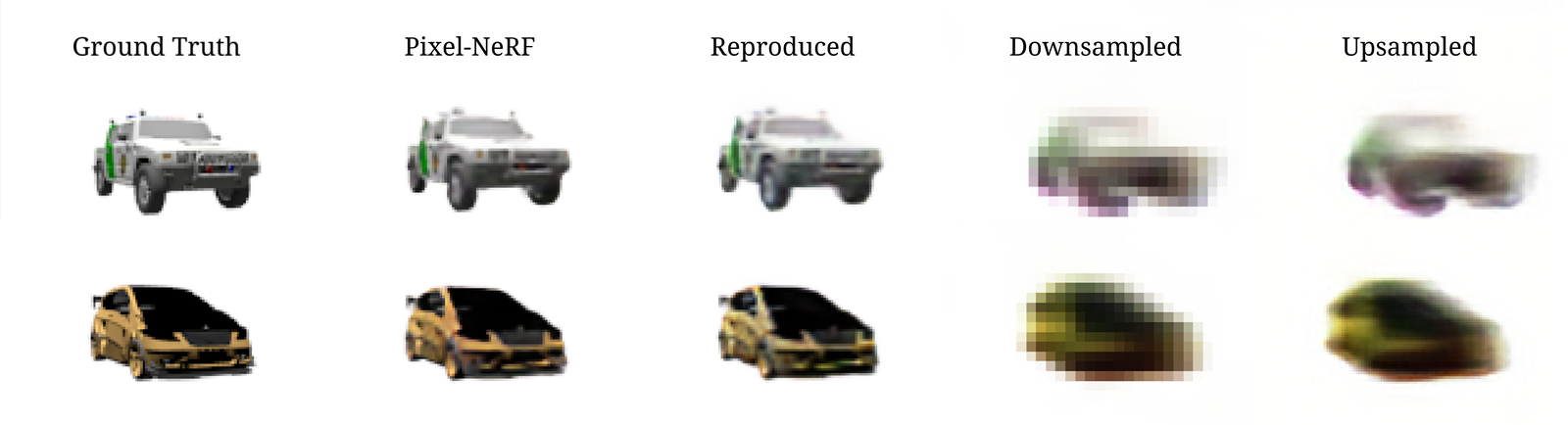
A TUM course project with Lars Schneider, Tobias Neumeier, and Adrian Struzek on accelerating pixelNeRF — a feed-forward Neural Radiance Field that predicts a scene from as little as one input image — by rendering at a lower resolution and recovering detail with a learned upsampler, rather than paying pixelNeRF’s per-ray cost at full resolution.
Highlights
- Reformulated pixelNeRF training and inference to run on full downsampled images (32×32 instead of the original 128×128) rather than randomly sampled ray batches, so the model can be trained end-to-end on every pixel.
- Recovered detail with a lightweight sub-pixel-convolution CNN upsampler (~200K parameters), trained with a combined MSE + VGG-16 perceptual loss on Flickr30k in the YCbCr domain.
- Cut pixelNeRF’s inference time on SRN-Cars by roughly 19x (2.44s → 0.13s) while retaining reasonable rendering quality (SSIM 0.76 vs. 0.88 for the original), with similar gains on CO3D-Apple.
- Benchmarked the trained upsampler alone against bicubic interpolation on Set5 (4x rescaling): the VGG-loss variant reached PSNR 28.41 / SSIM 0.823, beating bicubic’s 26.85 / 0.781.
Abstract
In recent years, Neural Radiance Fields (NeRF) has advanced the field of novel view synthesis by enabling high-quality 3D scene reconstruction from sparse input images. However, the computational cost of traditional NeRF models remains a limitation which inhibits its usage in fields with high performance or real-time requirements, such as augmented and virtual reality.
pixelNeRF addresses some of these challenges by learning a scene prior, eliminating the need for per-scene optimization. We speed up pixelNeRF by training on full images instead of randomly sampled rays. To achieve this, we first render at a lower resolution, significantly reducing computational requirements. Afterward, a convolutional upsampler recovers high-resolution details, reducing inference times while maintaining as many details as possible.
We evaluate our approach on the SRN-Cars and CO3D-Apple datasets. Our results demonstrate substantial improvements in inference speed without losing output quality.
Method
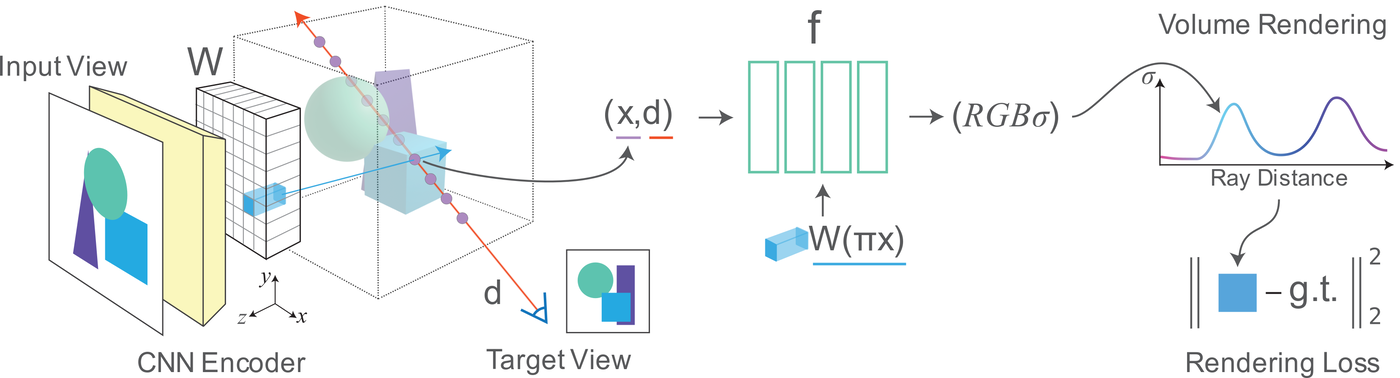
Instead of processing randomly sampled rays, the model is trained on full but downsampled images — 32×32 in place of the original 128×128 — reducing computational load during both training and inference. At test time, pixelNeRF renders a low-resolution image which is then scaled back up to the original resolution by a neural upsampler based on a sub-pixel convolutional architecture. The pixelNeRF network and the upsampler are trained separately rather than end-to-end, and a VGG-16 perceptual loss is added alongside MSE during upsampler training to push for sharper, more detailed output.
Results
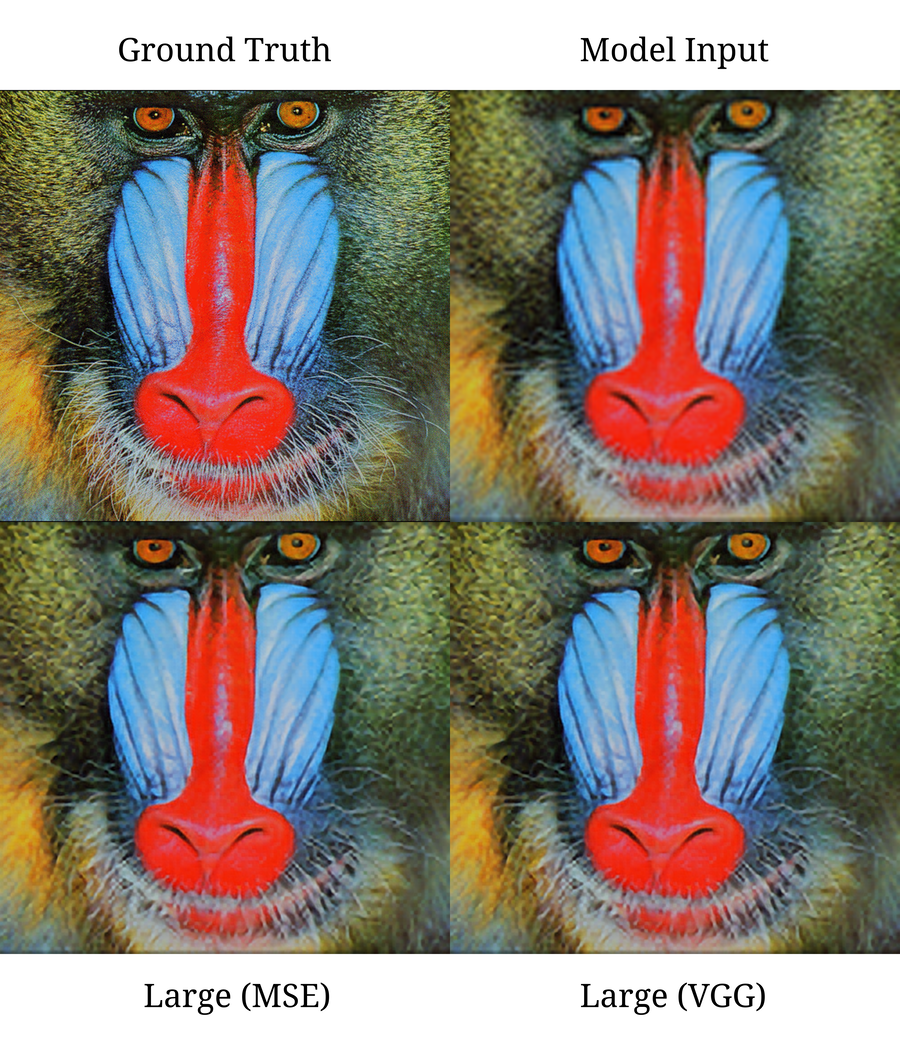
Upsampler alone. Evaluated on the Set5 benchmark at a 4x rescaling ratio, the upsampler’s larger (~200K-parameter) variant trained with the VGG perceptual loss reached PSNR 28.41 / SSIM 0.823, outperforming both its MSE-only counterpart and bicubic interpolation (26.85 / 0.781) — confirming the perceptual loss meaningfully improves reconstruction quality:
pixelNeRF + upsampling. Combining the downsampled pixelNeRF with the trained upsampler cut SRN-Cars inference time from 2.44s to 0.13s per view — roughly a 19x speedup — while keeping SSIM at 0.76 versus 0.88 for the original full-resolution model. CO3D-Apple showed a comparable trade-off. The remaining quality gap comes mostly from the extreme 16x downsampling factor and the upsampler’s relatively simple architecture, both flagged as the clearest directions for future work.
F. Förster, L. Schneider, T. Neumeier, and A. Struzek, “Speeding Up pixelNeRF by Upsampling Low-Resolution Images,” Technical University of Munich, 2025. Paper PDF.