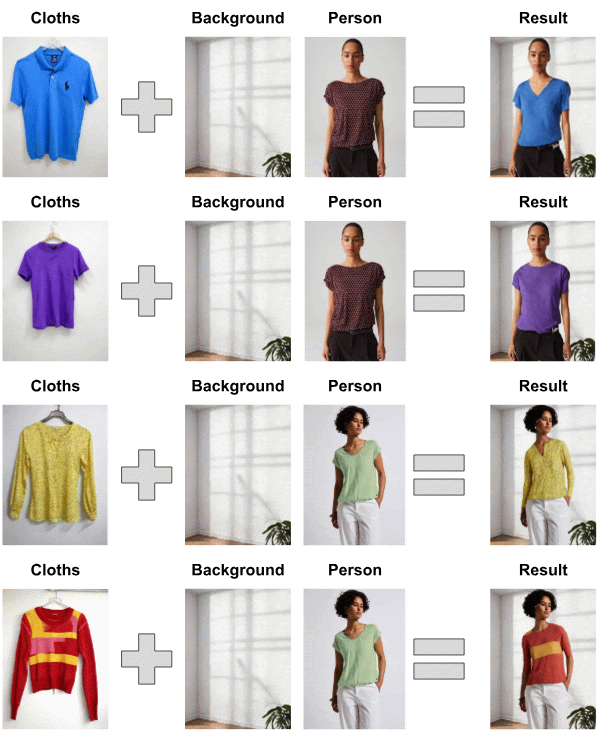
A TUM practical-course project with Andreas Weber, chaining together six public vision foundation models into a single pipeline for virtual try-on and semantic outfit editing: swap out the background and lighting of a photo, select the person to dress, generate a new garment from a text prompt, and fit it onto them — end to end, no manual masking or compositing. The animation above shows the pipeline’s inputs — a source garment, a new background, and a person photo — combining into the fitted result.
Highlights
- Orchestrated background generation, person segmentation and pose estimation, lighting harmonization, garment sourcing, and virtual fitting into one pipeline built from six independently maintained foundation-model repos, each forked and pulled in as a git submodule.
- Built and owned the backend serving layer: a single-client WebSocket server exposing the pipeline as seven request types (upload, background, design, fit, search_garment, choose_garment, rating), with request validation and session handling per connection.
- Added SLURM cluster support so the pipeline runs on TUM’s GPU cluster — allocation scripts and an SSH-forwarding startup script (
run_server.sh) that let a client connect to a pipeline running on an allocated compute node. - Worked around integration friction across independently developed foundation models — differing tensor dtypes (a BF16 fix in the background remover), skippable stages, and moving StableVITON’s fitting step to run standalone from its own fork.
How the pipeline fits together
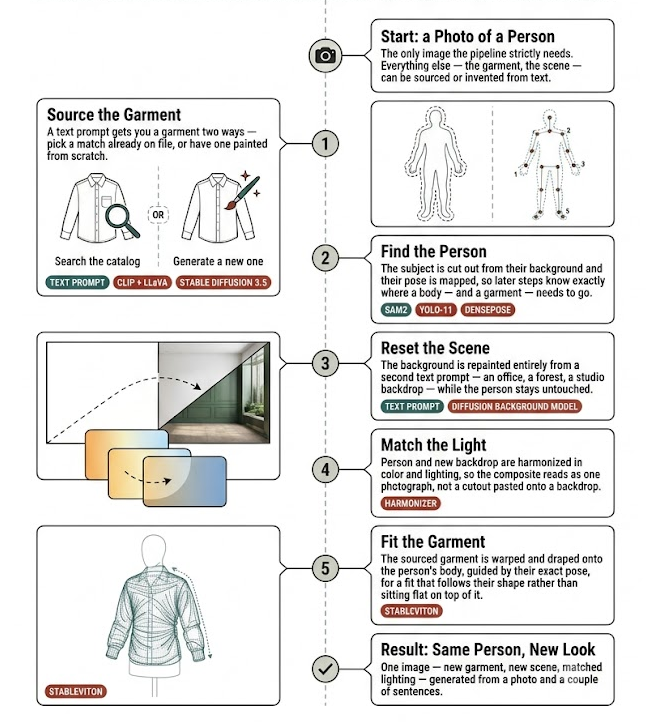
Six independently maintained foundation-model repos, each forked and wired in as a git submodule, are chained through a shared image/mask interface. Yahoo’s diffusion background generator repaints the scene behind the subject from a text prompt, and Harmonizer corrects the resulting lighting mismatch. The person is located with text-prompted segmentation (lang-segment-anything, i.e. SAM2 grounded by prompts like “person.” and “pants.”) and posed with DensePose. On the garment side, a catalog is searched with CLIP embeddings — captioned offline by LLaVA — or a new garment is generated from a text prompt with Stable Diffusion 3.5; either way, StableVITON then warps and fits it onto the person, guided by the DensePose result.
Results
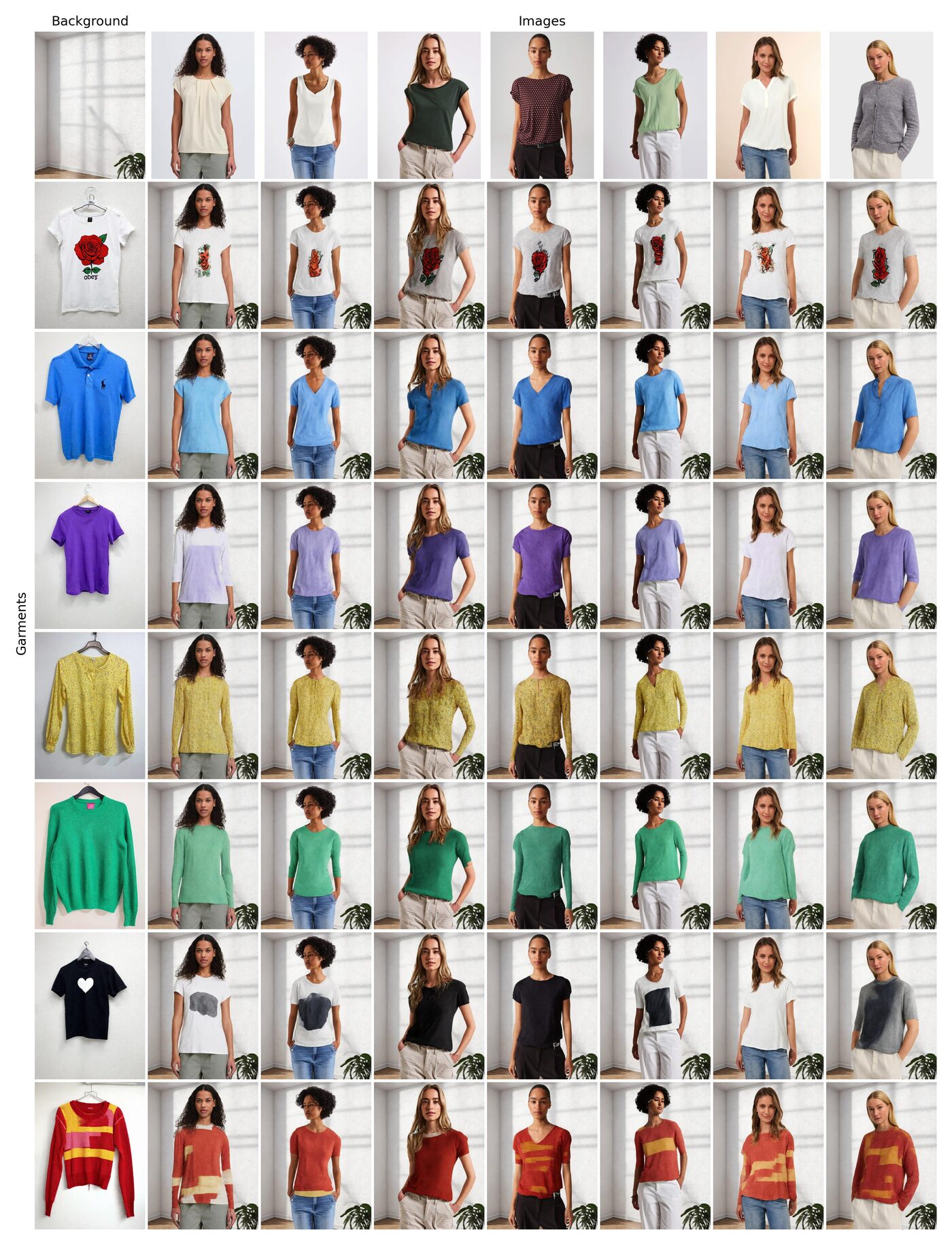
Background swaps across the top row, garment try-ons filling the grid below, generated on the VitonHD dataset, the standard benchmark for high-resolution virtual try-on.